A class implementing message processing as a daemon. More...
#include <tec_worker.hpp>
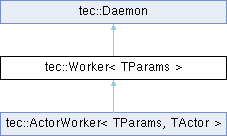
Public Types | |
| using | Params = TParams |
| Type alias for worker parameters. | |
| using | id_t = std::thread::id |
| Type alias for thread ID. | |
| using | Lock = std::lock_guard< std::mutex > |
| Type alias for mutex lock guard. | |
| using | CallbackFunc = std::function< void(Worker< Params > *, const Message &)> |
| Type alias for a callback function to process messages. | |
Public Member Functions | |
| Worker (const Params ¶ms) | |
| Constructs a worker. | |
| virtual | ~Worker () |
| Destructor that ensures proper thread termination. | |
| id_t | id () const |
| Retrieves the worker thread's ID. | |
| constexpr const Params & | params () const |
| Retrieves the worker's configuration parameters. | |
| const Signal & | sig_terminated () const override |
| Retrieves the signal indicating the worker has terminated. | |
| void | send (Message &&msg) override |
| Sends a message to the worker's queue. | |
| Status | make_request (Request &&req, Reply &&rep) override |
| Sends a request and waits for a reply in a daemon thread. | |
| template<typename Derived , typename T > | |
| void | register_callback (Derived *worker, void(Derived::*callback)(const Message &msg)) |
| Registers a callback for a specific message type. | |
| Status | run () override |
| Starts the worker thread's message polling. | |
| Status | terminate () override |
| Terminates the worker thread. | |
 Public Member Functions inherited from tec::Daemon Public Member Functions inherited from tec::Daemon | |
| Daemon ()=default | |
| Default constructor. | |
| virtual | ~Daemon ()=default |
| Virtual destructor for safe polymorphic deletion. | |
| Daemon (const Daemon &)=delete | |
| Daemons are non-copyable to ensure unique ownership. | |
| Daemon (Daemon &&)=delete | |
| Daemons are non-movable to ensure unique ownership. | |
| template<typename TRequest , typename TReply > | |
| Status | request (const TRequest *req, TReply *rep) |
| Helper: Sends a request and waits for a reply in a daemon process. | |
| template<typename TRequest > | |
| Status | request (const TRequest *req) |
| Helper: Sends a notification request – no reply required. | |
Protected Member Functions | |
| virtual void | dispatch (const Message &msg) |
| Dispatches a message to its registered callback. | |
| virtual Status | on_init () |
| Default callback invoked during worker thread initialization. | |
| virtual Status | on_exit () |
| Default callback invoked when exiting the worker thread. | |
| virtual Status | create_thread () |
| Create the Daemon's thread in suspended state. | |
Protected Attributes | |
| Params | params_ |
| Configuration parameters for the worker. | |
Detailed Description
A class implementing message processing as a daemon.
Implements the Daemon interface to manage a worker thread that processes messages from a SafeQueue. It supports registering callbacks for specific message types, provides default initialization and exit callbacks, and controls thread lifecycle with a signal for termination.
- Template Parameters
-
TParams The type of parameters used to configure the worker.
- Note
- Workers are non-copyable and non-movable to ensure unique ownership.
- See also
- Daemon
- Example: worker.hpp
- Common header – defines
TestWorkerparameters and messages.//// worker.hpp -- a common header.//#include "tec/tec_daemon.hpp"// Worker parameters.struct TestParams {// Add custom parameters.};// A compound message.struct Position {int x;int y;};// Actual Worker implementation exposed as Daemon.std::unique_ptr<tec::Daemon> create_test_worker(const TestParams&);Defines the minimal contract for any long-lived service or processing component.
- Example: worker.cpp
TestWorkerimplementation. Exposes theTestWorkerWorker as a Daemon.//// worker.cpp -- TestWorker implementation.//#include "tec/tec_worker.hpp"#include "worker.hpp"public:explicit TestWorker(const TestParams& params): tec::Worker<TestParams>{params}{// Register callbacks.register_callback<TestWorker, int>(this, &TestWorker::process_int);register_callback<TestWorker, std::string>(this, &TestWorker::process_string);register_callback<TestWorker, Position>(this, &TestWorker::process_position);}// Process `int` message.const int counter = std::any_cast<int>(msg);// Do something with `counter`...}// Process `std::string` message.auto str = std::any_cast<std::string>(msg);// Do something with `str`...}// Process `Position` message.auto pos = std::any_cast<Position>(msg);// Do something with `pos.x` and `pos.y`...}//~~~~~~~~~~~~~~~~~~~~~~~~~~~~~~~~~~~~~~~~~~~~~~~// Expose actual Worker implementation as Daemon.//~~~~~~~~~~~~~~~~~~~~~~~~~~~~~~~~~~~~~~~~~~~~~~~std::unique_ptr<tec::Daemon> create_test_worker(const TestParams&) {auto daemon{tec::Daemon::Builder<TestWorker>{}(params)};return daemon;}};std::any MessageType alias for a message that can hold any object.Definition tec_message.hpp:43Defines a worker class for processing messages in the tec namespace.
- Example: run.cpp
- Run the daemon. //// run.cpp -- run TestWorker as Daemon.// NOTE: The actual TestWorker implementation is completely hidden.// Compilation units `worker.cpp` and `main.cpp` are independent.//#include "tec/tec_status.hpp"#include "tec/tec_daemon.hpp"#include "worker.hpp"tec::Status run_test_worker() {TestParams params{};// Create a daemon.auto daemon = create_test_worker(params);// Start the daemon thread and check for an initialization error.auto status = daemon->run();if( !status ) {return status;}// Send different messages.// `process_int` will be called in the Worker's thread.daemon->send({7});// `process_string` will be called in the Worker's thread.daemon->send({std::string("This is a string!")});// `process_position` will be called in the Worker's thread.daemon->send({Position{2034, 710}});// Optional -- if we want to check an exit status.return daemon->terminate();}constexpr const Params & params() constRetrieves the worker's configuration parameters.Definition tec_worker.hpp:161Defines error handling types and utilities for the tec namespace.
Member Typedef Documentation
◆ CallbackFunc
Type alias for a callback function to process messages.
Defines a function that takes a Worker pointer and a Message to process.
Constructor & Destructor Documentation
◆ Worker()
◆ ~Worker()
Destructor that ensures proper thread termination.
Calls terminate() if the thread is joinable to ensure clean shutdown.
Member Function Documentation
◆ dispatch()
Dispatches a message to its registered callback.
Looks up the callback for the message's type in the slots table and invokes it if found.
- Parameters
-
msg The message to dispatch.
- See also
- register_callback()
◆ id()
|
inline |
Retrieves the worker thread's ID.
- Returns
- id_t The ID of the worker thread.
◆ make_request()
|
inlineoverridevirtual |
Sends a request and waits for a reply in a daemon thread.
This method sends an RPC-style request of type Payload to the daemon and waits for a corresponding reply of type Reply. It uses a signal to synchronize the operation and returns the status of the request processing.
- Parameters
-
req The request object to be sent. rep The reply object where the response will be stored.
- Returns
- Status The status of the request operation, indicating success or an error.
- See also
- Actor::process_request()
- ActorWorker
Implements tec::Daemon.
◆ on_exit()
|
inlineprotectedvirtual |
Default callback invoked when exiting the worker thread.
Called after the message loop, only if on_init() succeeded.
- Returns
- Status Error::Kind::Ok by default.
Reimplemented in tec::ActorWorker< TParams, TActor >.
◆ on_init()
|
inlineprotectedvirtual |
Default callback invoked during worker thread initialization.
Called before entering the message loop. If it returns a status other than Error::Kind::Ok, the worker stops and skips the message loop and on_exit().
- Returns
- Status Error::Kind::Ok by default.
Reimplemented in tec::ActorWorker< TParams, TActor >.
◆ params()
|
inlineconstexpr |
Retrieves the worker's configuration parameters.
- Returns
- const Params& The worker's parameters.
◆ register_callback()
|
inline |
Registers a callback for a specific message type.
Associates a member function of a derived class with a message type. The callback is stored in the slots table and invoked when a matching message is received. Should not be called while the worker is running.
- Template Parameters
-
Derived The derived worker class type. T The message type to associate with the callback.
- Parameters
-
worker Pointer to the derived worker instance. callback The member function to call for the message type.
- See also
- dispatch()
◆ run()
|
inlineoverridevirtual |
Starts the worker thread's message polling.
Creates the worker thread, signals sig_running_, and waits for initialization to complete. Returns the initialization status.
- Returns
- Status The result of the initialization.
- See also
- Daemon::run()
Implements tec::Daemon.
◆ send()
|
inlineoverridevirtual |
Sends a message to the worker's queue.
Enqueues a message for processing if the worker thread is joinable. Logs the operation using tracing if enabled.
- Parameters
-
msg The message to send.
- See also
- Daemon::send()
Implements tec::Daemon.
◆ sig_terminated()
|
inlineoverridevirtual |
Retrieves the signal indicating the worker has terminated.
- Returns
- const Signal& The termination signal.
- See also
- Daemon::sig_terminated()
Implements tec::Daemon.
◆ terminate()
|
inlineoverridevirtual |
Terminates the worker thread.
Sends a null message to stop the message loop if initialized successfully, waits for termination, and joins the thread. Should not be called from the worker thread.
- Returns
- Status The final status of the worker.
- See also
- Daemon::terminate()
- nullmsg()
Implements tec::Daemon.
The documentation for this class was generated from the following file: