Abstract interface for a daemon that runs in a separate thread. More...
#include <tec_daemon.hpp>
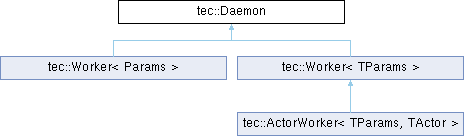
Classes | |
| struct | Builder |
| Factory for creating daemon instances. More... | |
Public Member Functions | |
| Daemon ()=default | |
| Default constructor. | |
| virtual | ~Daemon ()=default |
| Virtual destructor for safe polymorphic deletion. | |
| Daemon (const Daemon &)=delete | |
| Daemons are non-copyable to ensure unique ownership. | |
| Daemon (Daemon &&)=delete | |
| Daemons are non-movable to ensure unique ownership. | |
| virtual Status | run ()=0 |
| Starts the daemon's operation. | |
| virtual Status | terminate ()=0 |
| Terminates the daemon's operation. | |
| virtual void | send (Message &&msg)=0 |
| Sends a control message to the daemon. | |
| virtual const Signal & | sig_terminated () const =0 |
| Retrieves the signal indicating the daemon is terminated. | |
| virtual Status | make_request (Request &&, Reply &&)=0 |
| Sends a request and waits for a reply in a daemon process. | |
| template<typename TRequest , typename TReply > | |
| Status | request (const TRequest *req, TReply *rep) |
| Helper: Sends a request and waits for a reply in a daemon process. | |
| template<typename TRequest > | |
| Status | request (const TRequest *req) |
| Helper: Sends a notification request – no reply required. | |
Detailed Description
Abstract interface for a daemon that runs in a separate thread.
A daemon is a process or thread that runs continuously in the background and handles periodic service messages and requests. This interface defines the minimum set of methods and signals that a derived class must implement, including starting, terminating, sending messages, requests, and signaling state changes.
- Note
- Daemons are non-copyable and non-movable to ensure unique ownership.
- See also
- Worker
Constructor & Destructor Documentation
◆ Daemon()
|
default |
Default constructor.
Initializes a Daemon base class. Derived classes should provide specific initialization logic.
◆ ~Daemon()
|
virtualdefault |
Virtual destructor for safe polymorphic deletion.
Ensures proper cleanup of derived classes.
Member Function Documentation
◆ make_request()
Sends a request and waits for a reply in a daemon process.
This method sends a request of type Request to the daemon and waits for a corresponding reply of type TReply. It uses a signal to synchronize the operation and returns the status of the request processing.
- Parameters
-
req The request object to be sent. rep The reply object where the response will be stored.
- Returns
- Status The status of the request operation, indicating success or an error.
- See also
- Worker::make_request()
Implemented in tec::Worker< TParams >, and tec::Worker< Params >.
◆ request() [1/2]
Helper: Sends a notification request – no reply required.
- See also
- make_request()
◆ request() [2/2]
Helper: Sends a request and waits for a reply in a daemon process.
This method sends a request of type TRequest to the daemon and waits for a corresponding reply of type TReply. It uses a signal to synchronize the operation and returns the status of the request processing. If the request cannot be sent, a runtime error status is returned.
- Template Parameters
-
TRequest The type of the request object. TReply The type of the reply object.
- Parameters
-
req Pointer to the request object to be sent. rep Pointer to the reply object where the response will be stored.
- Returns
- Status The status of the request operation, indicating success or an error.
- See also
- make_request()
◆ run()
Starts the daemon's operation.
Initiates the daemon's background process or thread. Must be implemented by derived classes.
- Returns
- Status The result of the start operation.
Implemented in tec::Worker< TParams >, and tec::Worker< Params >.
◆ send()
Sends a control message to the daemon.
Allows external components to send a message to the daemon for processing. Must be implemented by derived classes.
- Parameters
-
message The message to send.
Implemented in tec::Worker< TParams >, and tec::Worker< Params >.
◆ sig_terminated()
Retrieves the signal indicating the daemon is terminated.
Returns a reference to the signal that indicates the daemon has stopped. Must be implemented by derived classes.
- Returns
- const Signal& The termination signal.
Implemented in tec::Worker< TParams >, and tec::Worker< Params >.
◆ terminate()
Terminates the daemon's operation.
Stops the daemon's background process or thread. Must be implemented by derived classes.
- Returns
- Status The result of the termination operation.
- See also
- sig_terminated()
Implemented in tec::Worker< TParams >, and tec::Worker< Params >.
The documentation for this class was generated from the following file: